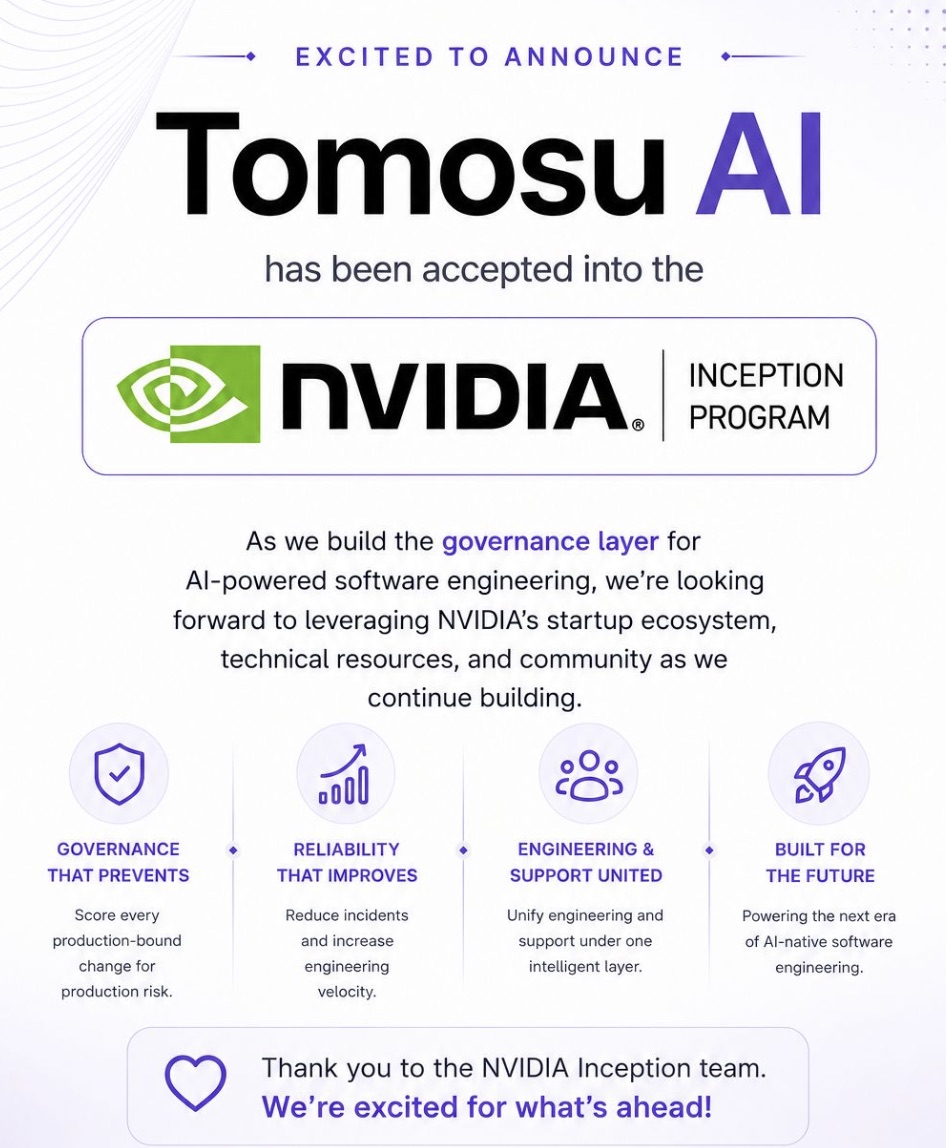
For the past decade, software delivery evolved through distinct waves. Each wave removed a bottleneck. AI has just removed the last one — and in doing so, exposed a layer no one built.
Infrastructure gave way to the cloud. CI/CD accelerated deployment. Observability helped teams understand production. AI coding assistants dramatically increased engineering velocity. Every one of these waves did the same thing: it took a constraint that used to slow teams down and dissolved it.
Developers are no longer limited by how quickly they can write code. That bottleneck is gone. Organizations are now limited by something the previous waves never had to answer for — how confidently they can govern what gets written.
The industry is building horizontally
Several exciting companies are solving different parts of the engineering lifecycle. AI-assisted development. AI code review. Static analysis. Application security. Runtime observability. Customer support. Each one improves a single stage of the pipeline, and improves it well.
Very few attempt to connect all of them into a single decision. The market is building across the pipeline — horizontally — when the thing organizations actually need is a layer that reasons vertically across every stage at once. That vertical layer has a name, and it is not security, and it is not review.
Governance is different from security
It is easy to assume governance is a rebrand of security, or a heavier code review. It is neither. Each existing discipline answers a real but narrow question, and none of them answers the question a business actually needs answered before code ships.
That last question is different in kind, not degree. The answer does not live in the source code. It depends on everything the source code cannot see.
Governance is a business decision informed by engineering — not an engineering decision alone.
To answer it honestly you have to weigh production history, operational reliability, customer impact, deployment patterns, ownership, support incidents, previous failures, organizational policy, and the AI-generated risk signals attached to the change itself. No single tool in the pipeline holds all of that. Each holds one slice.
The next platform layer
We believe Software Governance becomes a layer of its own — the layer that sits above AI coding, code review, security, observability, and CI/CD. Not a replacement for any of them. Those tools are the sources of truth for their own domains, and they should keep getting better at what they do.
Governance does something none of them was built to do: it orchestrates their intelligence into a single production decision. It treats every existing tool as an input and produces the one output the business is accountable for.
Rather than replacing these tools, governance orchestrates their intelligence into a single production decision. The pipeline builds the software. The governance layer decides whether it ships.
Why the category arrives now
Categories do not get defined on schedule. They get defined when a constraint moves. For twenty years the constraint was output — teams could not produce software fast enough, so every wave of tooling attacked production speed. Governance was a meeting, a checklist, a senior engineer's judgment applied to a volume of change small enough for a human to hold in their head.
AI broke that assumption. When agents author a large and growing share of the change, human judgment stops scaling as the volume of decisions climbs. The question is no longer can we produce this. It is should we allow this — asked hundreds of times a day, faster than any review meeting can keep up with. That is the exact shape of a problem that needs its own layer.
As AI agents begin creating software autonomously, organizations will increasingly need AI agents responsible for deciding whether that software should ship.
The symmetry is the whole point. Autonomous authoring on one side has to be met by autonomous governance on the other, or the confidence gap the first wave opened never closes. An organization that can generate a thousand changes but can only confidently govern a hundred has not gained velocity — it has moved the bottleneck one step to the right and called it progress.
What this means for Tomosu
This is the category we are building. Tomosu treats governance as a first-class layer: it reads the signals your pipeline already produces, weighs them against your production record and your policies, and resolves them into a Production Reliability Index and a defensible ship-or-hold decision at the merge gate — a decision an engineering leader can stand behind, and an auditor can trace.
We believe that future has already begun.
Tomosu builds the Software Governance layer for AI-assisted development. If your teams are shipping agent-authored change faster than any human can confidently govern it, we're opening a small design partner cohort.
Talk to us → · Questions: contact@tomosu.ai