Company
About Tomosu Our Team
Platform
Platform & Agents Indexes How it works Solutions Pricing
Get Started
MCP Server Integrations · GitHub App Integrations · CodeRabbit MCP Integrations · VS Code — Plugin Installation Integrations · Scan Your Repo Guide FAQ
Free Tools
Governance Impact
Resources
Blogs News Book a call →
Tomosu AI — VS Code Extension

Installation Guide

Get Tomosu AI running inside VS Code, Cursor, or Antigravity in under two minutes. Install from the Marketplace, sign in, and start scanning your codebase for reliability issues immediately.

Setup timeUnder 2 minutes
EditorsVS Code · Cursor · Antigravity
AuthEmail or Google
OutputPRI score · recommendations

01What is Tomosu AI?

Tomosu AI is a reliability governance layer that works directly inside your editor. Once installed, you can scan any file or workspace and receive a Production Risk Index (PRI) score — a number from 0 to 100 that measures how production-ready your code is across eight reliability dimensions.

The same analysis runs on pull requests via the GitHub App and inside AI assistants via the CodeRabbit MCP integration. The editor extension is the fastest way to get a score on any repository before you open a PR.

Free edition. The extension is free to install. Sign in with your work email or Google account to unlock scan results and connect to VisionBoard.

02Installation Steps

1
Open the Extensions panel in VS Code

Click the Extensions icon in the Activity Bar on the left side of VS Code (or press Ctrl+Shift+X / ⌘⇧X). This opens the Extensions Marketplace view.
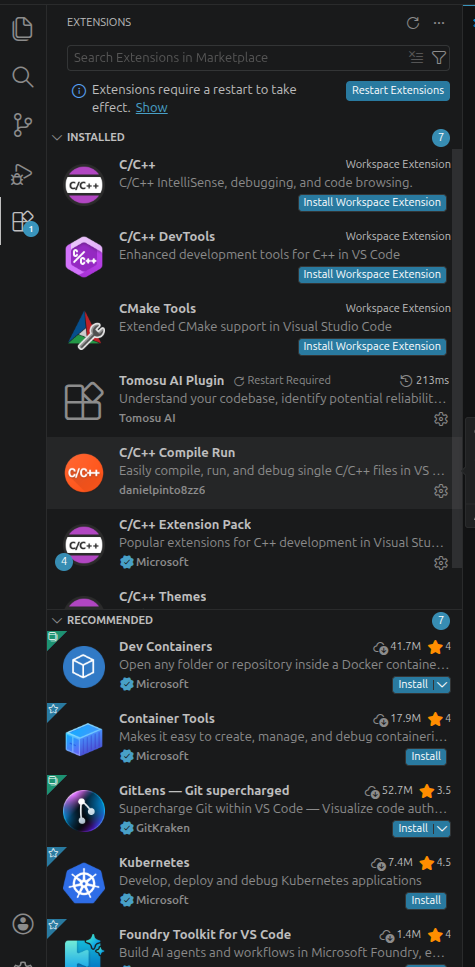
VS Code Extensions panel showing installed extensions in the sidebar Activity Bar.
Fig. 1 — The Extensions panel in VS Code, accessible from the Activity Bar
2
Search for "Tomosu" in the Marketplace

Type tomosu in the search box at the top of the Extensions panel. You will see the Tomosu AI Plugin listed. Click Install on the entry that shows “Understand your codebase, identify potential reliability concerns.”
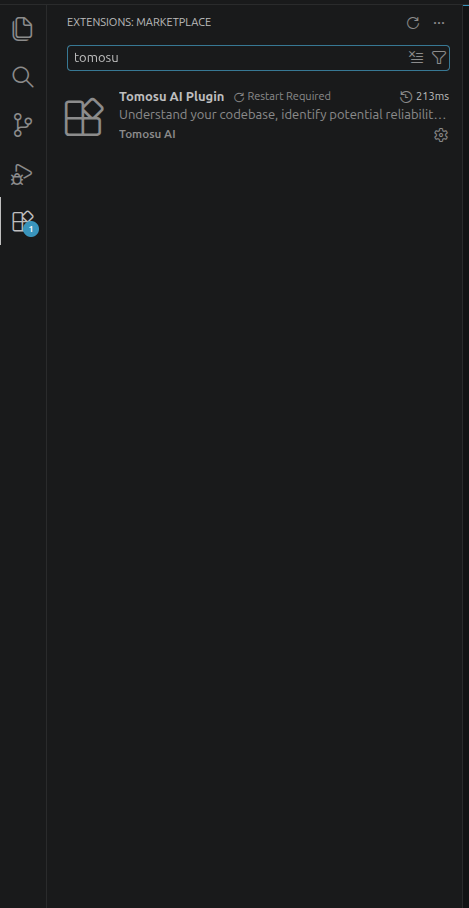
VS Code Extensions Marketplace search results for 'tomosu', showing two Tomosu AI Plugin entries with an Install button.
Fig. 2 — Search results for “tomosu” in the Marketplace
3
Review the extension details and click Install

Clicking the extension name opens the full detail page. Confirm this is Tomosu AI Plugin by tomosuai, then click the blue Install button. The extension installs in seconds with no additional configuration.
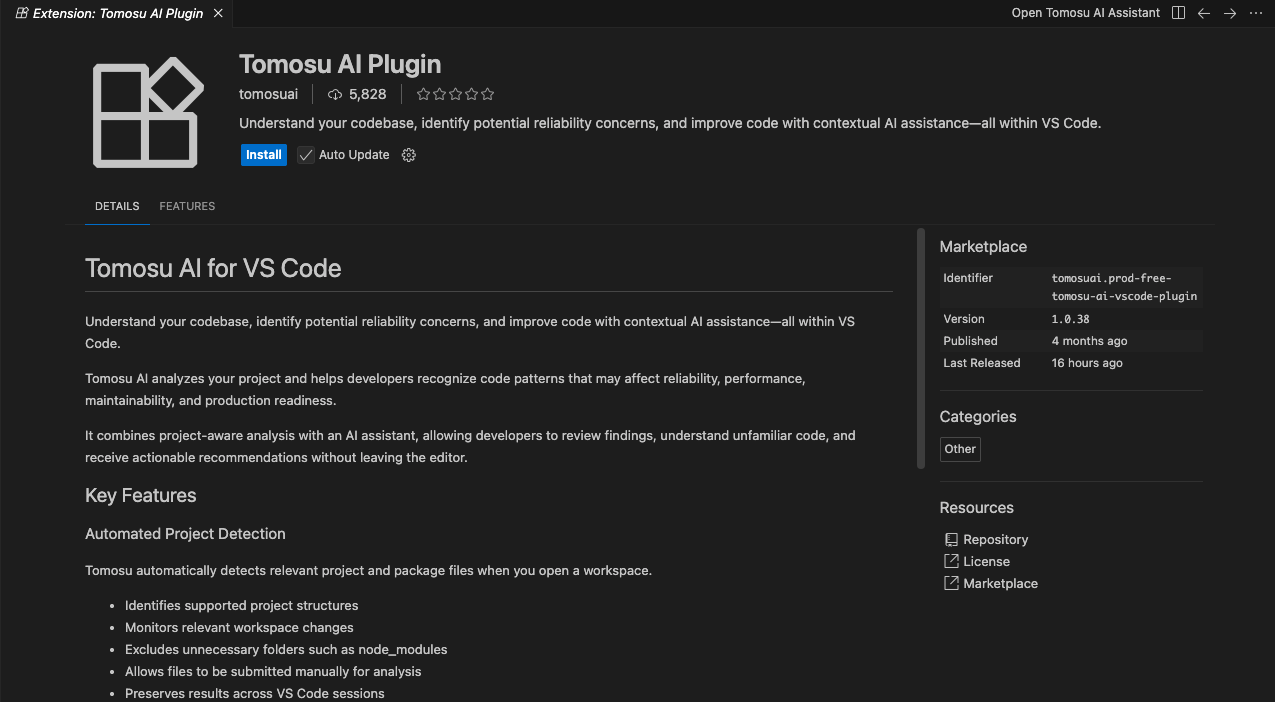
The full Tomosu AI Plugin marketplace detail page inside VS Code, showing version 1.0.38, 5,828 downloads, and the Install button.
Fig. 3 — The Tomosu AI Plugin detail page with the Install button
4
Sign in to your Tomosu AI account

After installation, the Tomosu AI Assistant panel opens automatically. You will be prompted to log in. Enter your work email and password, or click Google to sign in with your Google account. If you do not have an account yet, click Register.
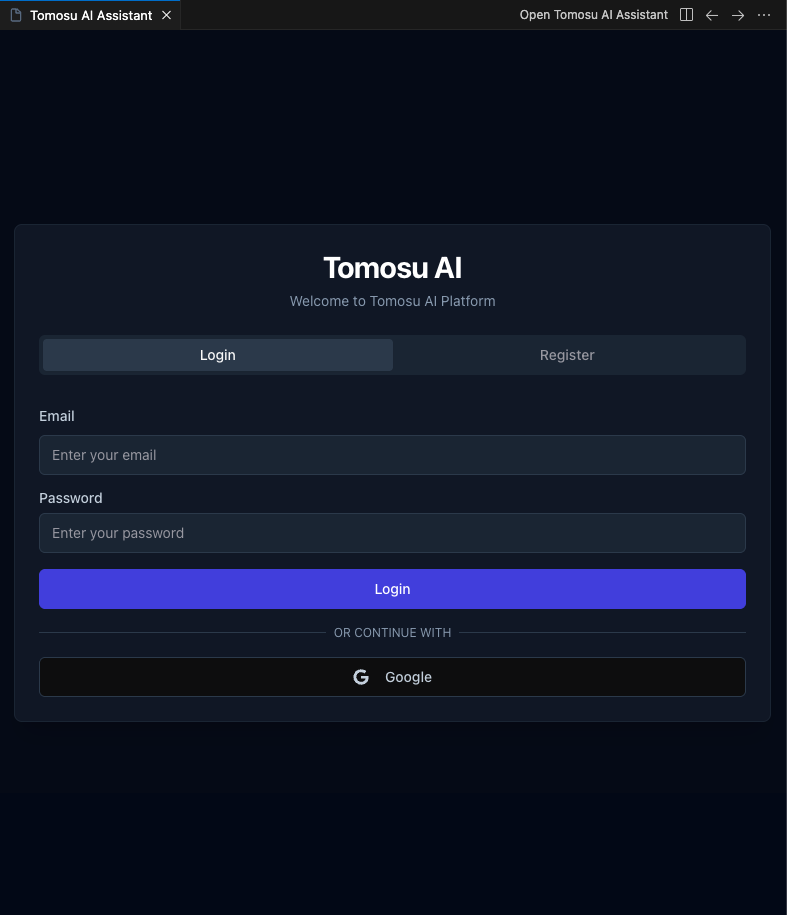
The Tomosu AI login screen inside VS Code, showing Login and Register tabs, email and password fields, and a Google sign-in button.
Fig. 4 — The Tomosu AI sign-in screen — log in or register to activate the extension
5
The Tomosu AI Assistant panel is ready

Once signed in, you land on the main Tomosu AI Assistant panel. Your account ID appears in the top-right corner. From here you can run a CodeScan, open VisionBoard, access GitAgent, or ask the AI assistant questions about your codebase.
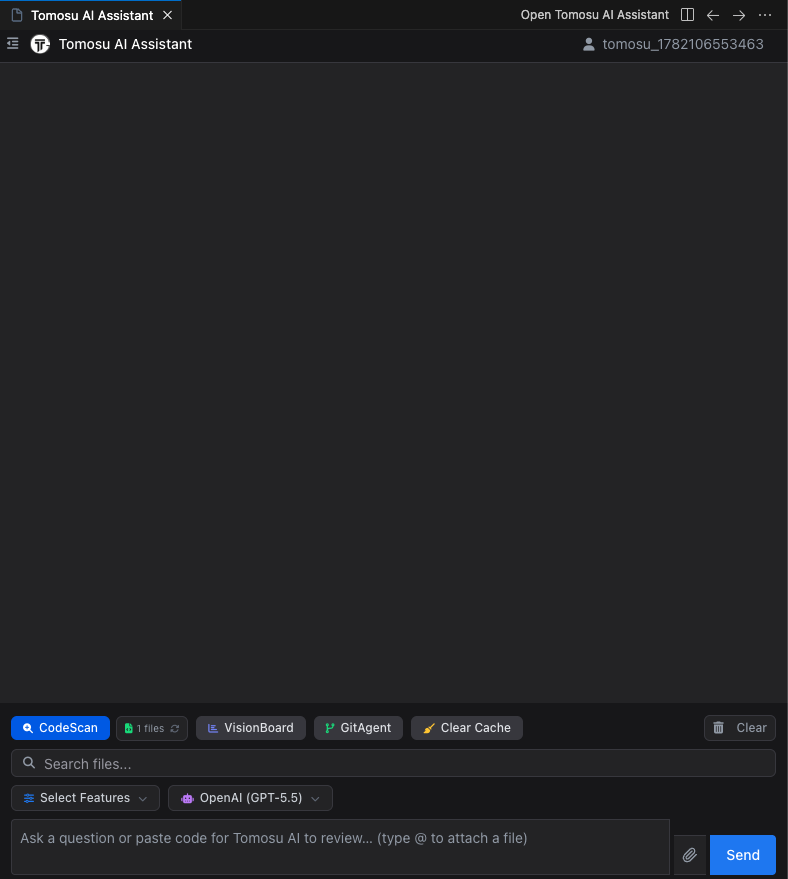
The Tomosu AI Assistant panel after sign-in, showing CodeScan, VisionBoard, GitAgent, and Clear Cache action buttons, plus a file search bar and the AI chat input.
Fig. 5 — The Tomosu AI Assistant panel — signed in and ready to scan

03Running a Code Scan

A code scan analyses your open workspace against eight reliability dimensions and produces a Production Risk Index (PRI) score. The scan is read-only — it never modifies your files.

6
Click CodeScan to run a reliability analysis

Click the CodeScan button at the bottom of the panel. Tomosu automatically detects the files in your workspace, runs the analysis, and posts the results in the panel. A typical scan takes under three minutes.

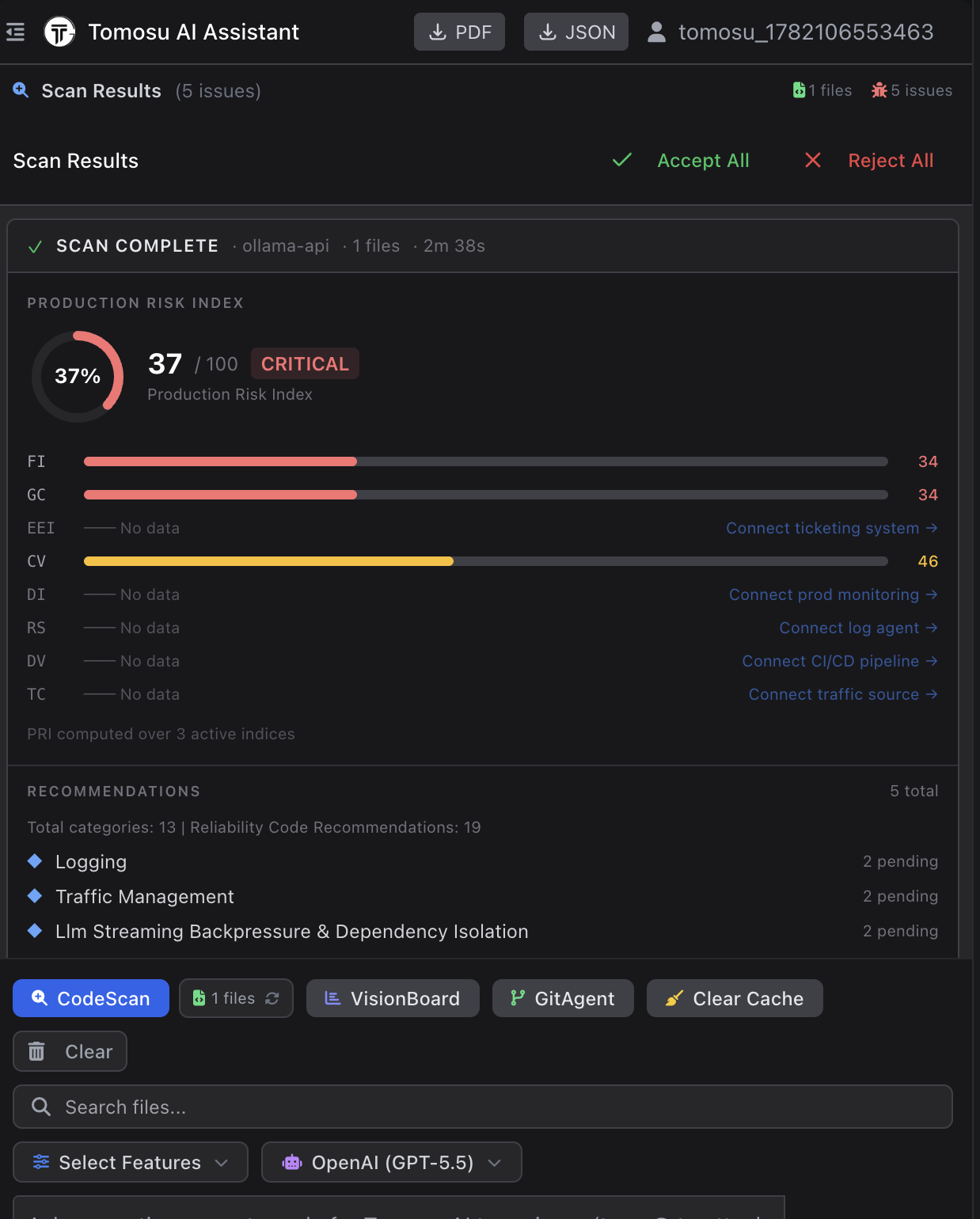
The results show your overall PRI score out of 100, sub-scores for each active index (FI, GC, CV, and more), and a prioritised list of recommendations grouped by category. Indexes with no data prompt you to connect the relevant signal source (ticketing system, CI/CD pipeline, log agent, etc.).

Tomosu AI Scan Results panel showing a PRI of 37 out of 100 (CRITICAL), with FI and GC scores at 34, CV at 46, and a recommendations list including Logging, Traffic Management, and LLM Streaming Backpressure.
Fig. 6 — Scan results: PRI score, sub-index breakdown, and prioritised recommendations

04Reviewing Your Results

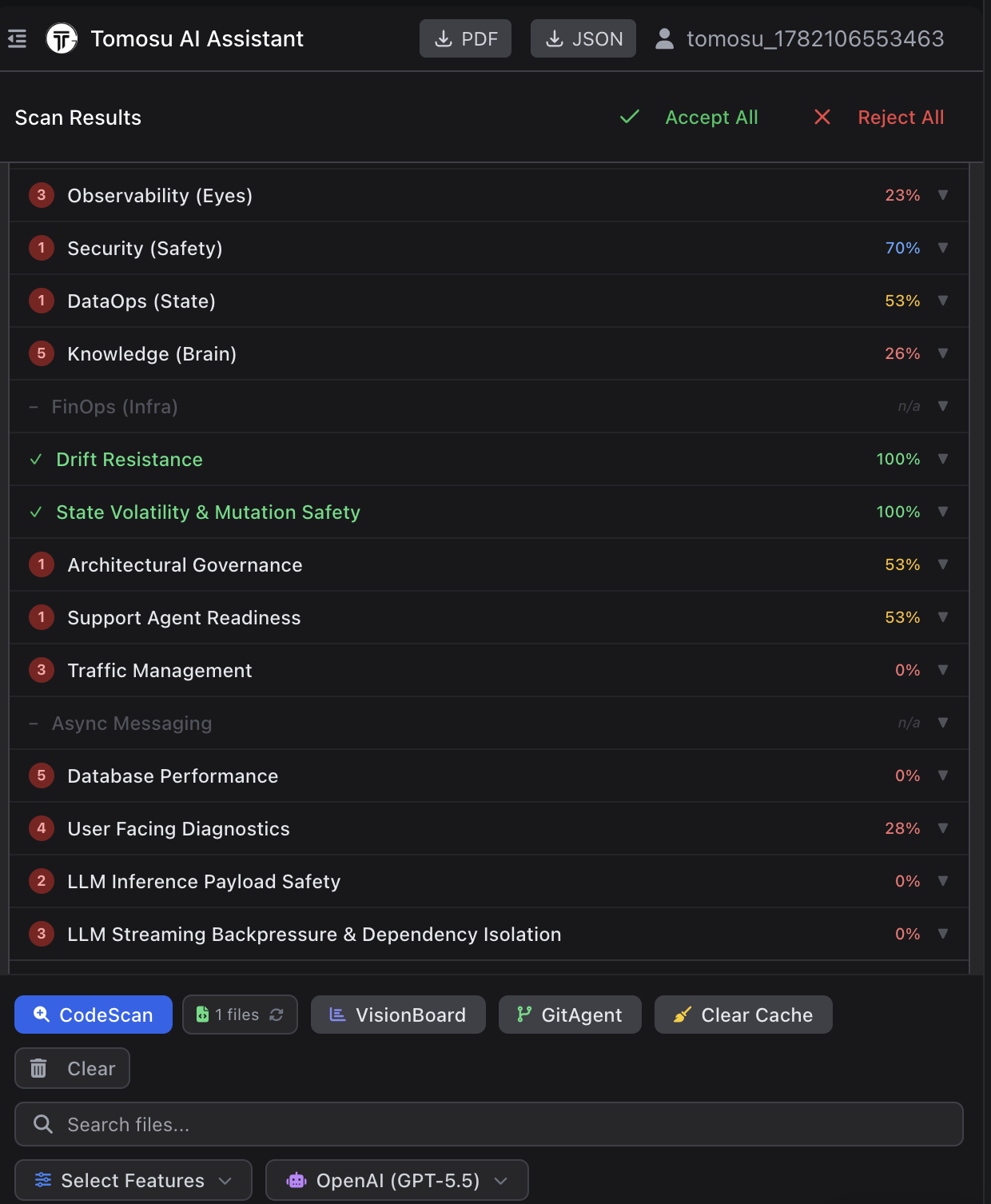
The scan results panel has two levels of detail. The top level shows your PRI score and the recommendations grouped by category. Expanding a category shows every finding inside it with a pass/fail status and a percentage score.

7
Review recommendations by category

Scroll through the full category list to see which areas of your codebase are strong and which need attention. Categories at 100% are shown in green with a checkmark — these are areas where your code already meets reliability standards. Categories at 0% or below 50% are the highest-priority items to address before shipping.

Tomosu AI Scan Results showing the full category breakdown: Observability at 23%, Security at 70%, DataOps at 53%, Drift Resistance at 100% (green), Traffic Management at 0%, and more.
Fig. 7 — Category-level breakdown — green checkmarks indicate fully passing areas
8
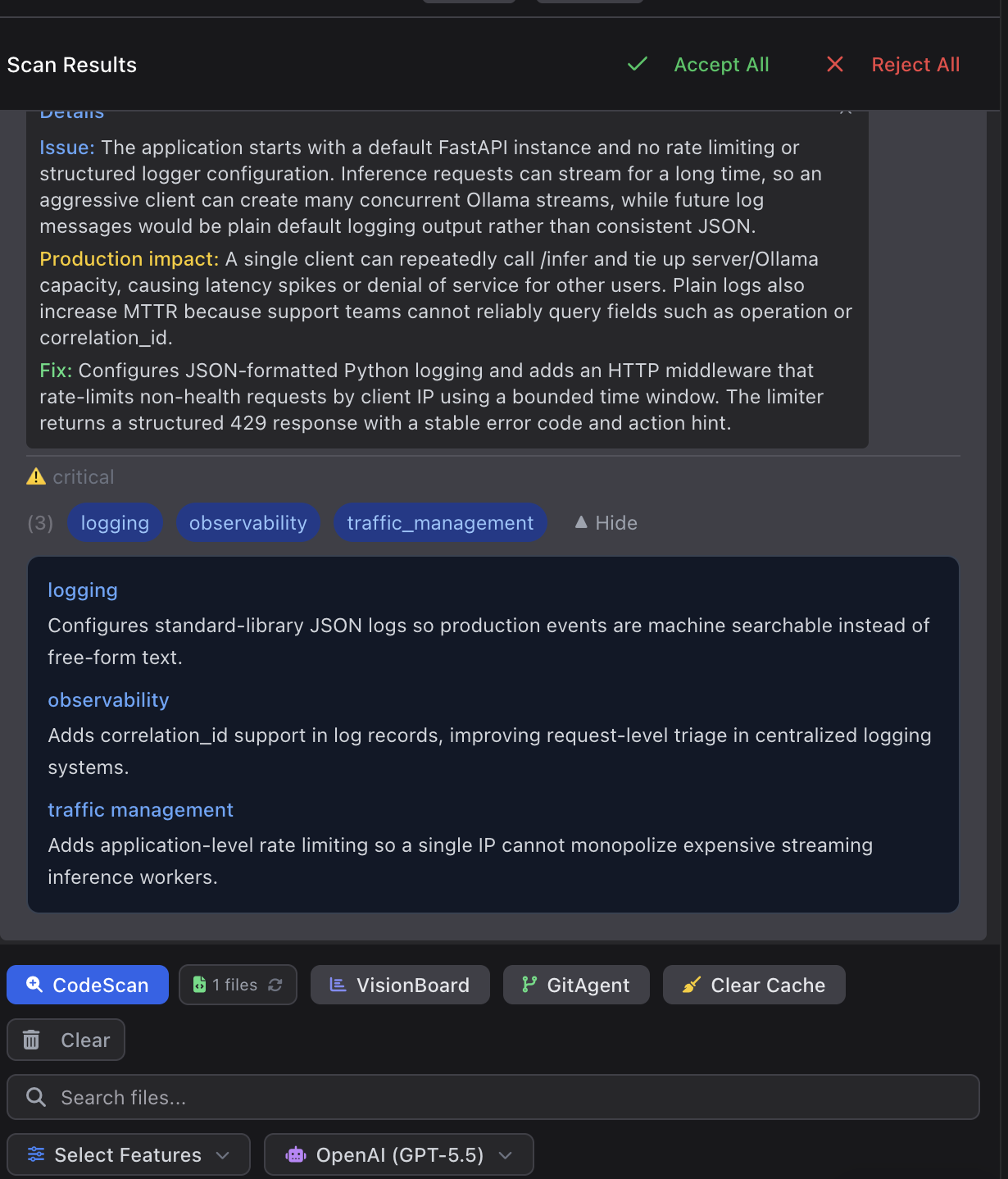
Open a finding for the full issue detail and fix

Click any recommendation to expand the Details panel. Each finding includes three parts:

  • Issue — what the problem is and why it matters technically
  • Production impact — what can go wrong in production if left unaddressed
  • Fix — a concrete, ready-to-apply code change that resolves the issue

Below the details you will see the associated code patches tagged by category (logging, observability, traffic management, etc.). Click Accept All to apply all fixes at once, or review them individually.

Tomosu AI finding detail panel showing Issue, Production impact, and Fix descriptions, followed by three code patch cards tagged with logging, observability, and traffic management.
Fig. 8 — A single finding expanded: issue, production impact, fix, and code patches

05Managing the Extension

Switching accounts

To sign out or switch accounts, click your account ID in the top-right corner of the Tomosu AI Assistant panel and choose Sign Out. You will be taken back to the login screen.

Downloading scan results

After a scan completes, use the PDF and JSON buttons in the top bar of the results panel to export your scan report in either format. The JSON export is useful for integrating PRI scores into your CI pipeline or tracking them over time in your own tooling.

Clearing the cache

Click Clear Cache in the action bar to remove locally cached scan data. This forces a fresh analysis the next time you run CodeScan, which is useful after significant refactors.

Uninstalling

To remove the extension, open the Extensions panel (Ctrl+Shift+X / ⌘⇧X), search for Tomosu AI Plugin, click the gear icon, and select Uninstall. Your account and scan history on VisionBoard are not affected by uninstalling the local extension.

Also using GitHub or CodeRabbit? Connect Tomosu to your pull-request workflow with the GitHub App or enrich CodeRabbit reviews via the MCP integration.